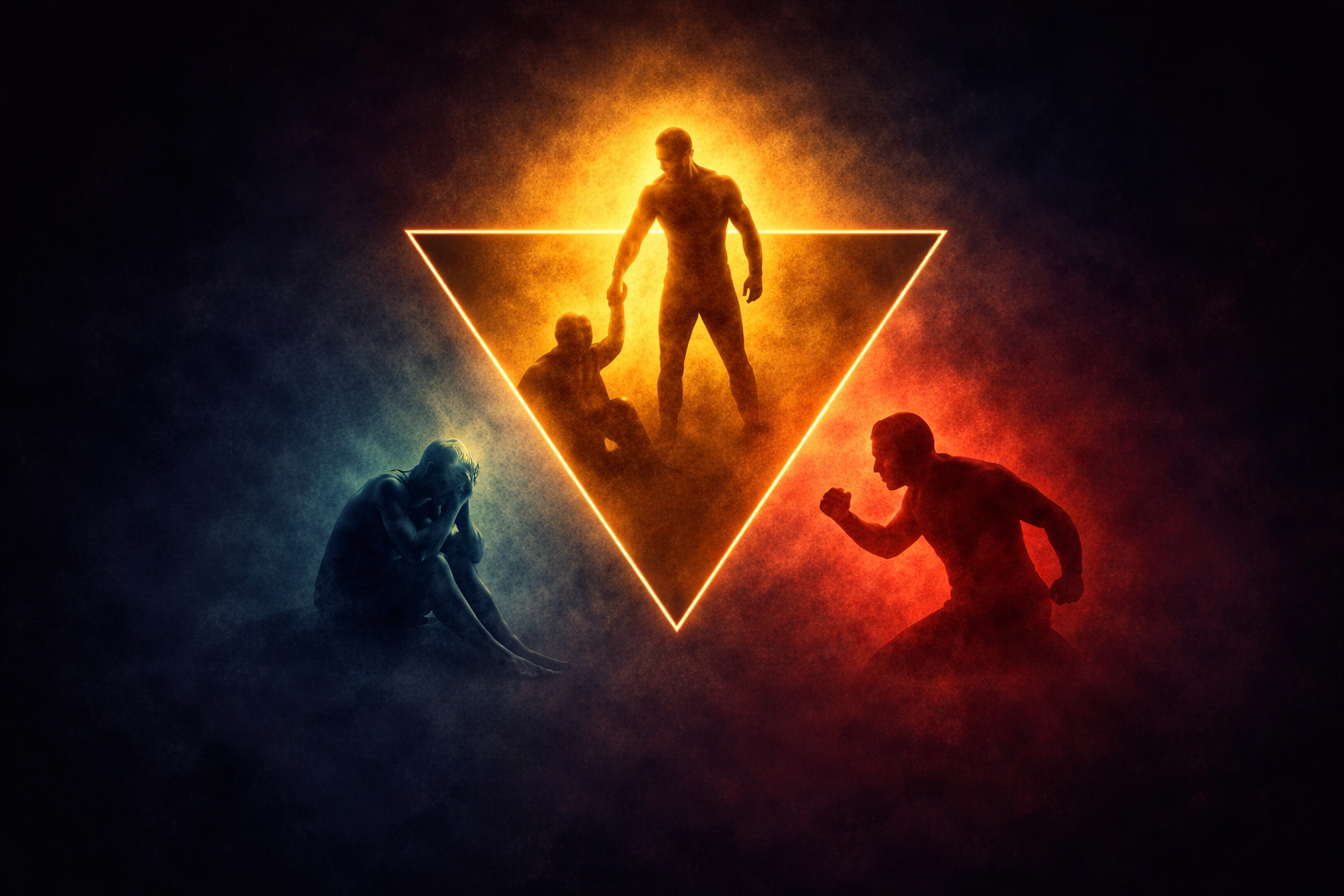
Joel and Antonia dive into the “hero” role in the drama triangle, revealing why it’s the most seductive, and potentially the most dangerous, identity of the three. They explore how the desire to be seen as good or selfless can mask deeper insecurities, fuel control dynamics, and create dependency. Through psychological models, cultural critique, and personal reflection, they offer the “coach” role from the Empowerment Dynamic as a more balanced, sustainable path to real empowerment and growth.
- by Personality Hacker
The Drama Triangle - "Hero Role" | Podcast 624
- by Personality Hacker


Share:
The Drama Triangle - "Villain Role" | Podcast 623
13 Reasons You Can’t Figure Out Your MBTI Personality Type | Podcast 625
1 comment
I wanted to add to the conversation! Great episode as always. i love this series!
Here are some thoughts from my experience. While I can absolutely cling in certain circumstances to the role of being the hero or the victim (less often the villain) there’s another layer to it that’s more dynamic than identity (even though both elements are at play).
Here’s a real life situation. My sister (mid 30s) and my mother (late 70’s) live together. Both of them struggle financially. They have a pattern of telling their apartment complex that they’re not renewing their lease without having any sense of where their next apartment will be. A few years back they did this and found that literally no other apartment would qualify them because their income was too low and their credit was bad. Down to the wire my sister found a NICE! (Yay!) apartment for them that was no longer in the slums but they’d require a co-signer (me & husband). And money for the application fees (us again). And… the $1,000+ deposit (also us). They lived at this nice apartment for a couple of years than literally did the same thing recently. But because i was unable to co-sign this time they couldn’t move! This was all concluded 3 days before they needed to turn in their key. Because i’m aware of the drama triangle and in therapy (well, mostly because i’m newly self employed) i needed to be a coach instead of a hero. We encourage her to explain her situation to her current apartment complex and ask if they have anything available for them to move into. it cost them $1000+ to move their stuff from one apartment to the other in the same complex. Had they known how it would unfold they would have stayed at their current apartment.
a good portion of the time we’re cast in roles because if we uphold boundaries we’ll either lose relationship or absorb some of the fallout of the other persons natural consequences. “Let my mom go homeless” or “co-sign and pay their deposit”.
My therapist pointed out how we play musical chairs in the triangle. I play the hero by helping them out but they literally don’t seem thankful. it doesn’t even seem to register to them that i did something deserving of thanks (regarding their avoidable situation). That knocks me down to victim. And if i were to bring up that i feel overlooked she may switch from victim to villain and tell me why i don’t deserve acknowledgement (maybe, maybe not).
I think of how much my dad would play the villian but if you even hinted at a situation he caused he could flip into victim just long enough to make you never want to do that again. Because if he’s the victim that means somehow i’m the villian?! how scary! A child caused their family’s suffering?
They cling to a certain identities and now I’m “forced” to be the hero. Yet there were so many times when i thought i was supposed to enable people which was me clinging to my identity/role. Sometime we force others into it and sometimes its forced upon us. And then we all take turns switching chairs on the titan. Good times.
Joel was right when he talked about heros spiral to martyrdom. You go from unthanked hero to the victim. This is how the triangle is dynamic. It’s easy to lash out (vilian) when you feel like the underdog (victim). Agency / boundaries / accepting natural consequences / letting relationships dissolve. there’s loss and reasonability outside of the triangle. it takes a lot of growth to show up as the coach, creator or challenger when the other person feels the change as a dagger to their safety.
i love you guys!