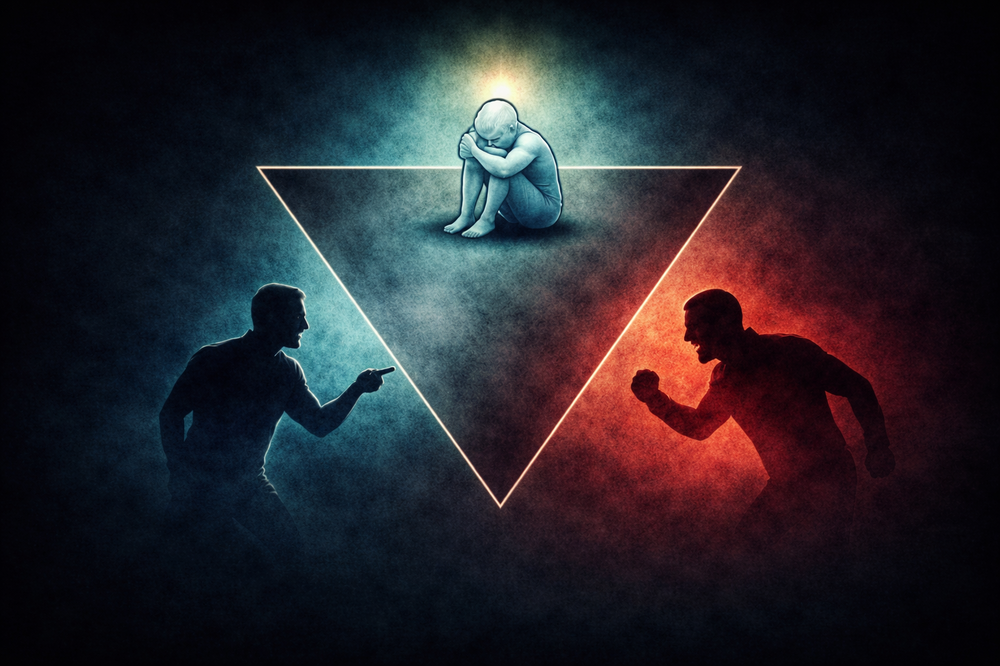
Joel and Antonia explore the difference between being a victim and identifying as one, using personal stories and the drama triangle. They introduce the Empowerment Dynamic as a more generative lens and challenge listeners to rethink helplessness and reclaim agency.
- by Personality Hacker
The Drama Triangle - "Victim Role" | Podcast 622
- by Personality Hacker


Share:
4 Personality Double Binds: Trapped, Exposed, Invalidated, or Out of Control | Podcast 621
The Drama Triangle - "Villain Role" | Podcast 623
3 comments
TLDR: the drama triangle seems to be a fundamentally individual framework not meant to be applied systemically. our interactions and experiences can be influenced at both the individual or group level.
I just listened to the episodes about the drama triangle and I find this framework so helpful for thinking about interpersonal conflict.
Particularly the conversation around victimhood. I appreciate the nuance and balance between analysis and personal anecdotes.
When the conversation turned towards systematic victims, I want to add another perspective. I think it’s hard to think about entire groups as being victimized bc as discussed, this can feel like solutions are out of reach and limited. One way to think about it is this…
There are individual interactions that make up most of our day to day lived experience. It feels easy to apply the drama triangle theory most immediately there. There are also systemic interactions that happen possibly less often and influence us on a longer scale. It’s not just about how you as an individual think of yourself though that can impact how you navigate systems. It’s also about literally what interactions you are having with the system at hand. And policies. Whether it be a smaller system like a church or a larger government, the roles map closer to policies. So instead of an individual playing the role of a villain, now the system plays different roles. And I don’t think the simple triangle holds here. There are probably more roles that could be outlined at that level.
I think it’s ok to recognize the drama triangle as a useful tool in conceptualizing individual level personal conflict. It’s also ok to underline that it is not a framework that should be immediately applied to systematic behaviors. I’d say it’s important to make this very clear. Otherwise, things can get quite problematic in terms of refusing to acknowledge actual large groups of people who have been targeted and harmed throughout world history e.g. the holocaust.
Thanks for another stimulating podcaste. On the systemic victimisation and individual agency. Its possible both of these things can be true. Viktor Frankl comes to mind. A Nazi concentration camp is perhaps the ultimate in systemic victimisation and people who were in them really were victims. Frankl’s point was that he retained agency over how he chose to respond those horrific situations. This didn’t mean he could actually do whatever he wanted to but it does mean he could maintain some sense of agency even when he really was a victim.
An interesting interpretation of the drama triangle I’ve heard is that some people will cast themselves in the “villain” role if they tend to blame themselves in any situation where there’s conflict or someone else is upset. In a sense, they’re taking too much responsibility but in a non-productive way, particularly if they can’t identify anything in particular that they did wrong.
Is this a habit you’ve encountered in anyone you’ve coached?