I
Introverted
For you, the internal world is the 'real world'. The real world for Extraverted (E) types is the external world.

An INFJ's hidden genius is their intuition about people. They seem to just "get" what's going on for others, and they're very often right. Even if the INFJ has never experienced those circumstances themselves, somehow they'll just know how a person is feeling and be able to show great empathy and understanding.
An insightful, empathetic type that loves to explore the depths of the human experience, INFJs offer a beautiful pairing of heart and wisdom to the world.
If you've spent your life understanding everyone around you better than they understand you, this page is the reverse: you, finally mapped.
For you, the internal world is the 'real world'. The real world for Extraverted (E) types is the external world.
You focus on meaning and pattern recognition. Sensing (S) types focus on what they observe with their 5+ senses.
You make decisions using personal criteria like human emotions and dynamics. Thinking (T) types prioritize impersonal criteria like data and metrics.
You prefer structure around you to free your mind and thoughts. Perceiving (P) types prefer freedom in the world around them and create structure internally.
Not sure INFJ is your best fit? INFJs are often confused with INFPs. Read the INFP vs INFJ comparison or take the free personality quiz.
Your mind has different parts that come online in different ways: the part that sees the pattern, the part that reads the room, the part that searches for the truth, and the part that tunes you into your experience.
The Personality Hacker Car Model™ gives you a simple way to track those parts without needing to master the whole theory first.
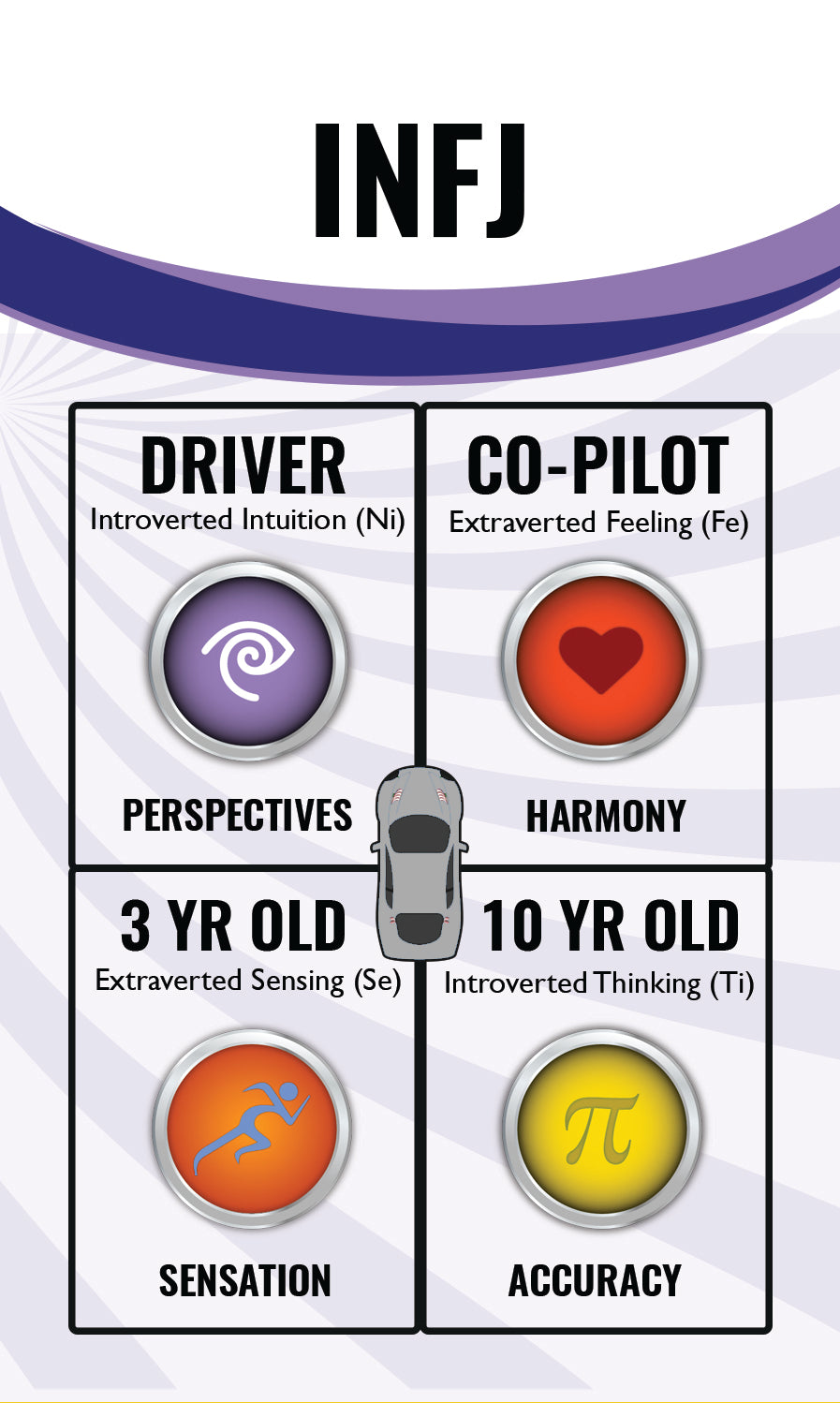

The part of you that tracks meaning, trajectory, symbolism, and future implications before they become obvious.

The part of you that tracks emotional impact, relational dynamics, shared needs, and the way people are affected by what is happening.

The part of you that connects with the body, the present moment, direct experience, beauty, pleasure, and the reality in front of you.

The part of you that searches for inner precision, clean logic, correct language, and the truth underneath emotional complexity.
Stress is not just "being stressed." It has a location. Sometimes it lives in the meaning you are making. Sometimes it shows up in your need to understand what someone meant, what they need, or where the situation is headed. Sometimes it hits the part of you that feels responsible for the emotional impact of the room. Sometimes it waits until your body finally checks out, shuts down, or starts looking for escape.
For INFJs, those patterns are not random. Your mind can start reading too much meaning into every signal. Your Harmony can turn care into over-responsibility. Your Accuracy can become a critical spirit, demanding clean truth from situations that are still messy, emotional, and hard to prove. Your body can become the place where everything you have been sensing finally catches up with you.
Most INFJs can name their stress. Almost none can locate it. This worksheet shows you where yours actually lives. Enter your name and email and we'll send it to you.
Over-interpreting signals, reading hidden meaning into everything, running future implications too far ahead, and disconnecting from the present.
Emotional absorption, over-responsibility, people-pleasing, overdone boundaries, door-slam energy, and resentment.
A critical spirit, harsh inner logic, over-explaining, and needing the truth to be clean before you can move.
Overstimulation, numbness, overindulgence, addictive behaviors, impulsive escape, and shutdown.

A full program on regulating the four channels: body, emotion, thought, and meaning.
Your number-one leverage point for growth is your co-pilot, Extraverted Feeling ("Harmony"). Harmony is how you understand where to put your boundaries, and it knows that getting human needs met must include your own.
Build a simpatico relationship between Harmony and your 10-Year-Old, Introverted Thinking ("Accuracy"). Done right, the tension between the two gives you integrity while encouraging you to help others.
Your growth will need to integrate your 3-Year-Old, Extraverted Sensing ("Sensation"). With time, you'll get better at knowing when to go to Sensation, how to rest into it, and when it has you in its grip.
 These three moves are the spine of the INFJ Owners Manual, where you actually build them. See what's inside →
You tune into your partner's needs so naturally that you often understand them better than they understand you. The trouble starts when that runs one way for too long, and it shows up in three recurring patterns.
INFJs can fixate so strongly on a partner's needs and viewpoints that they disappear in the process.
Intuition picks up that something is off, and INFJs can fill in the blanks with their best guess rather than asking directly, collecting little assumptions throughout the relationship.
INFJs can rush to "fix" a conflict before everyone is heard, or bury irritations until they reach a boiling point.


Those three mistakes have a shared root. Couples Mapping shows you and your partner how to rewire it, together.
You do your best work when it visibly lands on people. And you'll pour in far more than you get back before you admit that's a problem. It surfaces in three struggles.
Toxic workplaces fraught with conflict, tension, and stress can damage the internal terrain of an INFJ who stays too long. Many stay anyway, seeing themselves as the only person keeping the situation from being miserable.
INFJs cannot perpetually give without any compassion, satisfaction, or visible impact in return. When the work does not directly touch people, they need affirmation from someone above them, a real need that can feel childish to admit.
INFJs do their best thinking by going inside their minds and tuning out the world. Sudden noises or someone walking up behind them pulls them out of flow, and it takes time to get back in.
Struggles like these usually mean one of two things: the work doesn't fit how you're wired, or your real skill with people has never been trained and put to use. There's a path for each.

Explore Personality Profiler Training with Joel and Antonia. An immersive, practice-based program to train the skill of seeing personality in real situations. Develop presence, pacing, and perceptual accuracy. Includes Pillars of Personality.
 Work doesn't fit how you're wired? That's exactly what the Personality Life Path is built for. See the program below →

Joel and Antonia explore the four INFJ career subtypes based on Dr. Dario Nardi's research and what each style means for finding meaningful work.
The INFJ Owners Manual helps you work through the persistent question of what is yours to respond to and what is not. You will map how your mind tracks meaning, reads emotional impact, searches for precision, reconnects with the present moment, and protects your pattern recognition when other people's emotions start disrupting the signal.
The version of you on the other side of this work still reads every room — but no longer carries every room.



Get relief from your biggest challenges, lean into how you're wired, and build a life that fits - guided by Joel and Antonia in a live cohort.
New cohort starts soon